
Research question
Which functional and causal claims follow from the literal scalar recurrence and local reader rule, and which require explicitly added mechanisms or fail their declared task tests?
MODEL SCOPE
Public model description
The literal memory law, M(x,t+1) = αM(x,t) + βS(x,t), is a pointwise linear recurrence with no spatial transport. A local utility rule reads the field with attraction or avoidance. Agent-dependent writing, source motion and task scorers are separately declared diagnostic definitions; they are not recovered historical laws. Numerical closure, a causal channel and useful task performance require separate tests.
PROTOCOL
Declared evidence chain
Fourteen planned stages and V3R.7R test closure, historical zones, policy, persistence, history, effective dose, erased-target recall, cue interference, tracking, inter-agent cause, context, self-writing, shared service, stress and selected reproducibility. Paired worlds hold matched inputs and disturbances. Erasure, permutation, spatial shift, mediator cuts, replay and an assignment oracle separate mechanisms from task benefit. Frozen readout and continuing decay remain distinct; final selected reruns do not reexecute every earlier stage.
Series: V3R.1–V3R.14 + V3R.7R · scalar closure · functional memory · causal controls · finite robustness · selected reproducibility
- V3R.1–V3R.14 + V3R.7R
- scalar closure
- functional memory
- causal controls
- finite robustness
- selected reproducibility
The labels below preserve the public protocol identity. They are an index to the publication, not a substitute for its full methods or an open reproducibility bundle.
EVIDENCE
Results inside the model
INTERACTIVE MODEL LENS
Scalar memory audit lens
An explanatory view separates local scalar closure, useful retained state and the gates that stronger functional claims fail. The decorative field does not represent spatial transport, phase coupling or a rerun of the study.
Task-aligned traces guide frozen-readout navigation and history changes choice under matched current input. Effective-dose matching explains repetition without an extra learning mechanism.
- All 32 standard closure tasks pass. The literal recurrence is pointwise and linear, contains no spatial transport, and does not support the historical zone table as a lock/collapse partition.
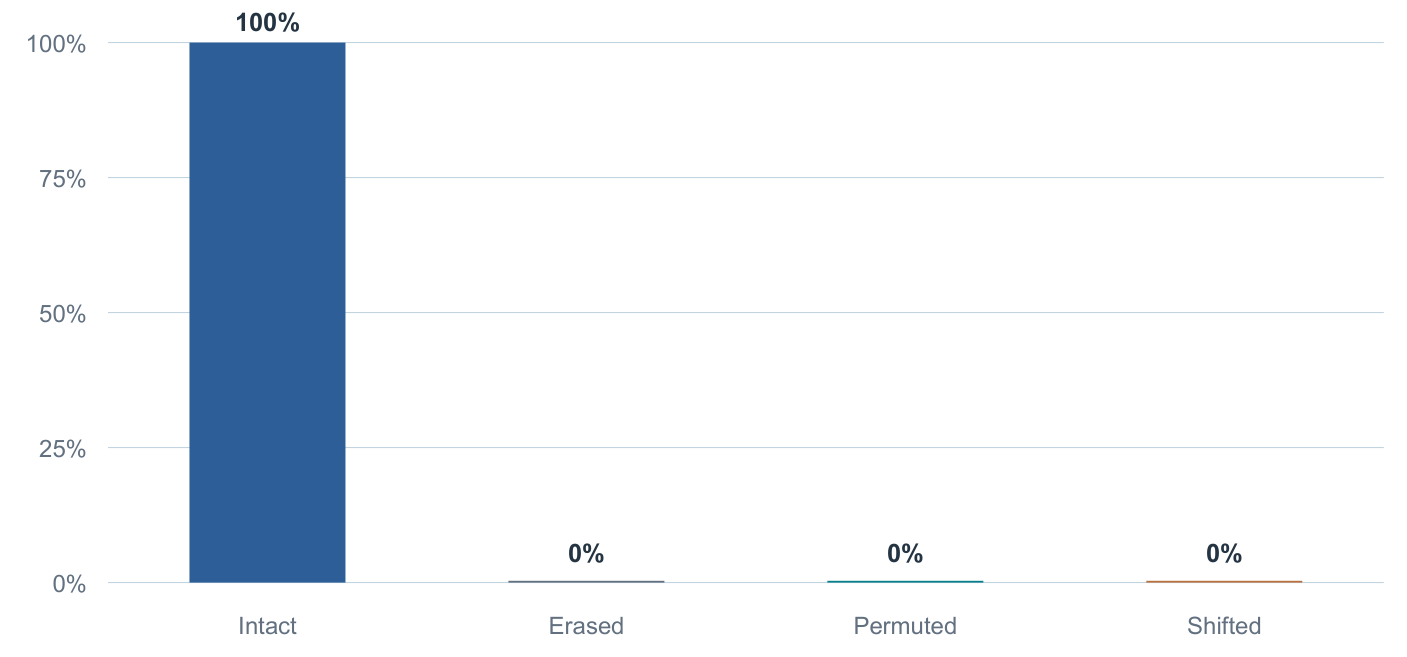
- In the primary frozen-readout assay, intact task-aligned memory gives 100% target success versus 0% for erased, value-permuted and spatially shifted controls. Under identical present input, the primary history-match probability is 93.46%.
- Effective-dose matching produces identical final fields and all 48 paired downstream trajectories. Erased uncued targets do not reconstruct. V3R.7R exactly reproduces 240 original cases and qualifies cue trapping in one frozen-readout geometry; the separate live-decay condition fails the baseline prerequisite for the same suppression claim.
- Observed-prefix tracking is supported, but primary blind continuation does not establish anticipation. Under exogenous input, interventions on one passive reader have exactly no effect on another; a detectable writer channel belongs to an explicitly added model.
- The primary self-writing loop increment is 0.09989 source widths (95% interval 0.09475–0.10419), below its prespecified effect requirement; selected exploratory attraction regimes qualify separately. Shared writing changes two-agent paths but leaves both service scores at 0.5 and all primary mutual gains at zero; a separate assignment oracle reaches 1 for each agent.
- The final selected audit exactly reproduces 36 archived worlds and passes 18 selected cases under repeat, reload and separate-process execution. Four spatial rasters preserve selected successes and failures at matched coordinate and behavioral scales. Driven reacquisition is distinct from source-free repair.
BOUNDARY
CLAIM BOUNDARY
- 01Declared numerical protocol
V3R.1–V3R.14 + V3R.7R · scalar closure · functional memory · causal controls · finite robustness · selected reproducibility
- 02Supported model-level finding
All 32 standard closure tasks pass. The literal recurrence is pointwise and linear, contains no spatial transport, and does not support the historical zone table as a lock/collapse partition.
- Claim boundary
- 03Requires a separate validation chain
Results belong to the literal scalar model and separately declared diagnostic extensions. Numerical validity, causal influence and task benefit remain distinct. Selected reruns do not reexecute the entire series or establish universal replication, a continuum limit, CPU/GPU equivalence, learning, semantic context, cognition, beneficial cooperation, quantum/plasma performance or a physical implementation. Operating settings, raw observations, source code and reconstruction materials are excluded from the public release.
Numerical evidence is not physical validation. Transfer to a material, device, organism, environment, or operational service requires a separate validation chain whenever such a transfer is relevant.
Publication record
- Author
- Nikita Teslia
- Programme
- Foundational systems
- Claim type
- Numerical evidence ledger
- Year
- 2026
- Publication date
- Report version
- 1.1
- Report date
- Report languages
- English
- Dossier review
- Series
- V3R.1–V3R.14 + V3R.7R · scalar closure · functional memory · causal controls · finite robustness · selected reproducibility
- License
- CC BY-NC-ND 4.0
- DOI
- 10.5281/zenodo.23234726
Citation
Teslia, N. (2026). V3R: Scalar Memory Fields Revisited — A Numerical Audit of Causal Mechanisms and Functional Limits (Version 1.1). Zenodo. https://doi.org/10.5281/zenodo.23234726Open publication recordThe DOI is the canonical external record. The site condenses the public publication and does not replace it.
PROGRAMME TOPOLOGY
Research lineage
Lineage records publication sequence and explicit revision or supersession links. It does not assert empirical causation or an otherwise unverified cross-branch dependence.