
Research question
Are replication-like persistence and ecology metrics supported by explicit mechanisms rather than by pattern tuning alone?
MODEL SCOPE
Public model description
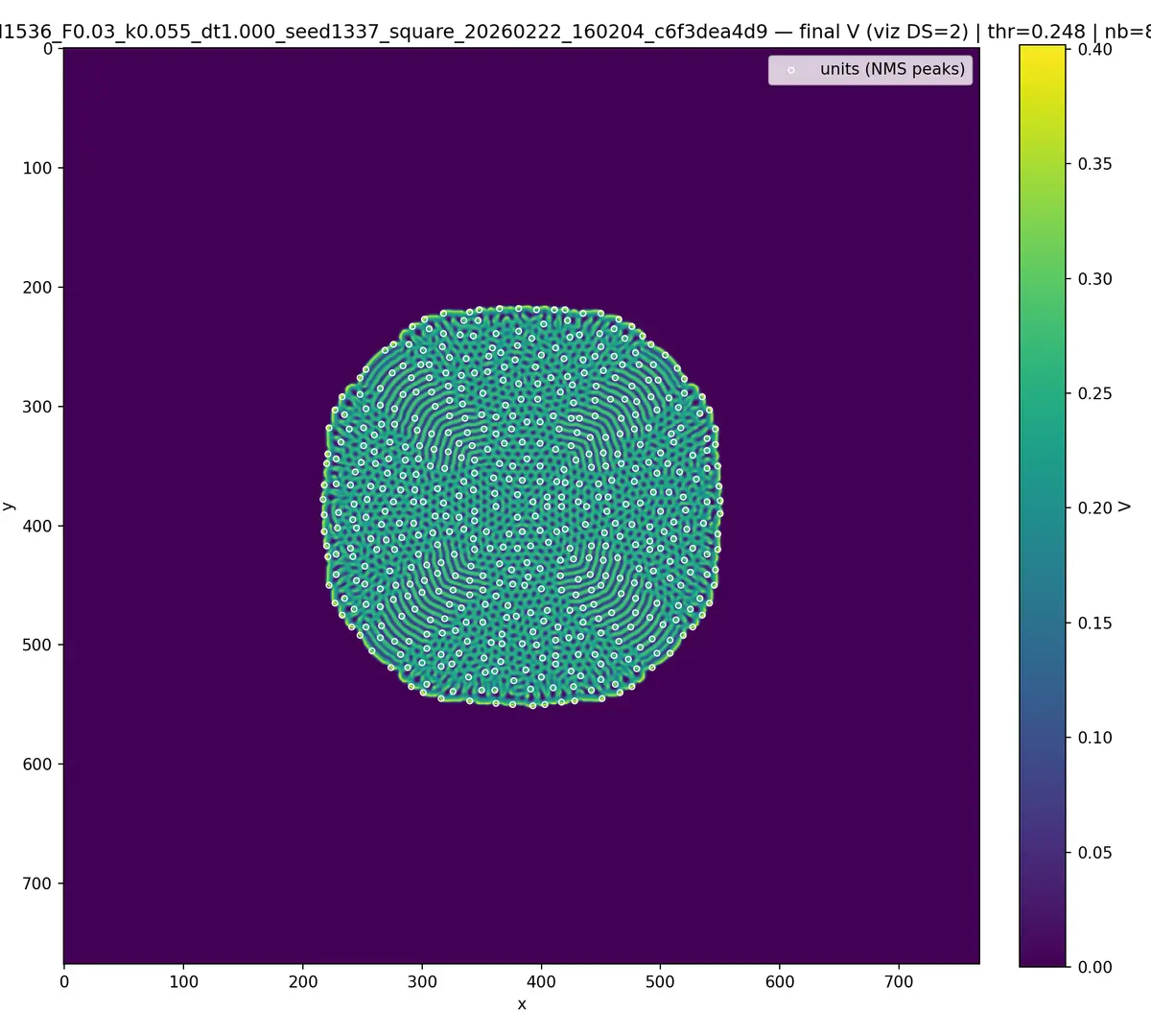
A Gray–Scott reaction–diffusion substrate is augmented with bounded template feedback, resource and genotype coupling, stress injection, and fixed unit detectors.
PROTOCOL
Declared evidence chain
Twelve groups use counterfactual template intervention, resource and stress sweeps, split-and-swap tests, selection, grid transfer, localized ablation, and multi-strain interaction protocols.
Series: V11-E1–V11-E12
- V11-E1–V11-E12
The labels below preserve the public protocol identity. They are an index to the publication, not a substitute for its full methods or an open reproducibility bundle.
EVIDENCE
Results inside the model
INTERACTIVE MODEL LENS
Template-ecology lens
A reaction–diffusion view of template intervention, the viability band, detected localized units, and the audited scale domain.
Detected units persist only inside the tested resource and stress band.
- Template necessity is supported by a do-intervention.
- A viability band, heredity-channel disruption, selection costs, and stress robustness are separated experimentally.
- Scaling transfer holds across tested grids except for a documented pathology at N = 1024; claims are anchored to N ≥ 1536.
BOUNDARY
CLAIM BOUNDARY
- 01Declared numerical protocol
V11-E1–V11-E12
- 02Supported model-level finding
Template necessity is supported by a do-intervention.
- Claim boundary
- 03Requires a separate validation chain
The ontology is operational and simulation-specific. It does not establish living organisms, biological heredity, cognition, or a hardware replicator; generalisation beyond the tested PDE class is not claimed.
Numerical evidence is not physical validation. Transfer to a material, device, organism, environment, or operational service requires a separate validation chain whenever such a transfer is relevant.
Publication record
- Author
- Nikita Teslia
- Programme
- Foundational systems
- Claim type
- Numerical proof-of-concept
- Year
- 2026
- Dossier review
- Series
- V11-E1–V11-E12
- License
- CC BY-NC-ND 4.0
- DOI
- 10.5281/zenodo.18767914
Citation
Teslia, N. (2026). V11: Template-Guided Replicator Ecology in Reaction–Diffusion Phase Fields. Zenodo. https://doi.org/10.5281/zenodo.18767914Open publication recordThe DOI is the canonical external record. The site condenses the public publication and does not replace it.
PROGRAMME TOPOLOGY
Research lineage
Lineage records publication sequence and explicit revision or supersession links. It does not assert empirical causation or an otherwise unverified cross-branch dependence.
No published successor is encoded in the current research graph.