
Research question
Does topology retain a measurable thermal effect after cumulative controller action and observable tensor state are closely matched?
MODEL SCOPE
Public model description
A reduced thermal-interface model couples heat transport to an observable anisotropic tensor state and a phase-field-style order/control variable under bounded cumulative action.
PROTOCOL
Declared evidence chain
T1.1–T1.10 move from balance and passive references through fixed-budget redistribution, negative controls, corrective replays, action normalisation, and a final source-aligned versus anti-hotspot topology comparison.
Series: T1.1–T1.10 · 88 figures
- T1.1–T1.10
- 88 figures
The labels below preserve the public protocol identity. They are an index to the publication, not a substitute for its full methods or an open reproducibility bundle.
EVIDENCE
Results inside the model
INTERACTIVE MODEL LENS
Topology-response lens
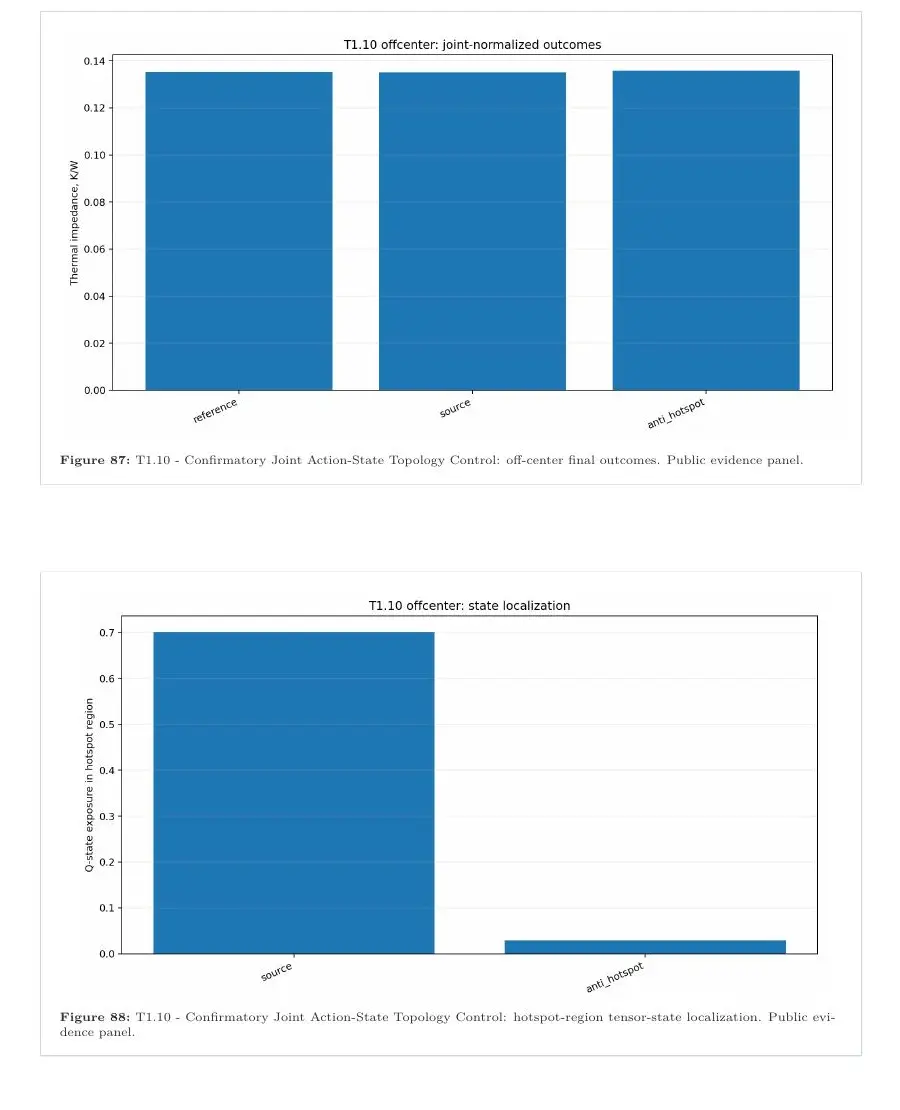
A normalized thermal-interface view of the reference, source-aligned, and anti-hotspot states after joint action–state matching.
Reported impedance improves by about 0.148% relative to reference.
- T1.9 is a negative result: after action normalisation, the least adverse hotspot policy remains 0.098% worse off-centre and 0.134% worse for the dual source.
- In T1.10 the source-aligned topology improves impedance by about 0.148% versus reference, while the anti-hotspot topology degrades it by about 0.255%.
- The final thermal separation is about 0.403%, with hotspot-state localisation separation ≈ 0.671.
BOUNDARY
CLAIM BOUNDARY
- 01Declared numerical protocol
T1.1–T1.10 · 88 figures
- 02Supported model-level finding
T1.9 is a negative result: after action normalisation, the least adverse hotspot policy remains 0.098% worse off-centre and 0.134% worse for the dual source.
- Claim boundary
- 03Requires a separate validation chain
The effect is small, controlled, and model-specific. It does not establish graphene kinetics, actuator energy, microscopic trajectory identity, laboratory thermal conductivity, manufacturability, or product performance.
Numerical evidence is not physical validation. Transfer to a material, device, organism, environment, or operational service requires a separate validation chain whenever such a transfer is relevant.
Publication record
- Author
- Nikita Teslia
- Programme
- Thermal systems
- Claim type
- Numerical proof-of-concept
- Year
- 2026
- Dossier review
- Series
- T1.1–T1.10 · 88 figures
- License
- CC BY-NC-ND 4.0
- DOI
- 10.5281/zenodo.21604565
Citation
Teslia, N. (2026). T1: Phase-Guided Graphene Thermal Interface. Zenodo. https://doi.org/10.5281/zenodo.21604565Open publication recordThe DOI is the canonical external record. The site condenses the public publication and does not replace it.
PROGRAMME TOPOLOGY
Research lineage
Lineage records publication sequence and explicit revision or supersession links. It does not assert empirical causation or an otherwise unverified cross-branch dependence.
No predecessor is asserted in the current research graph.
No published successor is encoded in the current research graph.