
Research question
Does phase guidance produce a reproducible clean operating regime for storage and transport under cycling, stress, steering, and grid changes?
MODEL SCOPE
Public model description
A phase-field storage and corridor-transport model is coupled to a phenomenological Li–few-layer-graphene effective-medium layer. The material label denotes an effective model, not microscopic electrochemistry.
PROTOCOL
Declared evidence chain
E1–E9 chain storage, controlled release, layered-medium ablation, mixed stress, aperture scaling, a bias–drain operating window, 20-cycle operation, bilateral steering, and seed/grid reproduction.
Series: E1–E9 · five seeds · 20 cycles · 1536/2048/4096 checks
- E1–E9
- five seeds
- 20 cycles
- 1536/2048/4096 checks
The labels below preserve the public protocol identity. They are an index to the publication, not a substitute for its full methods or an open reproducibility bundle.
EVIDENCE
Results inside the model
INTERACTIVE MODEL LENS
Guided accumulator lens
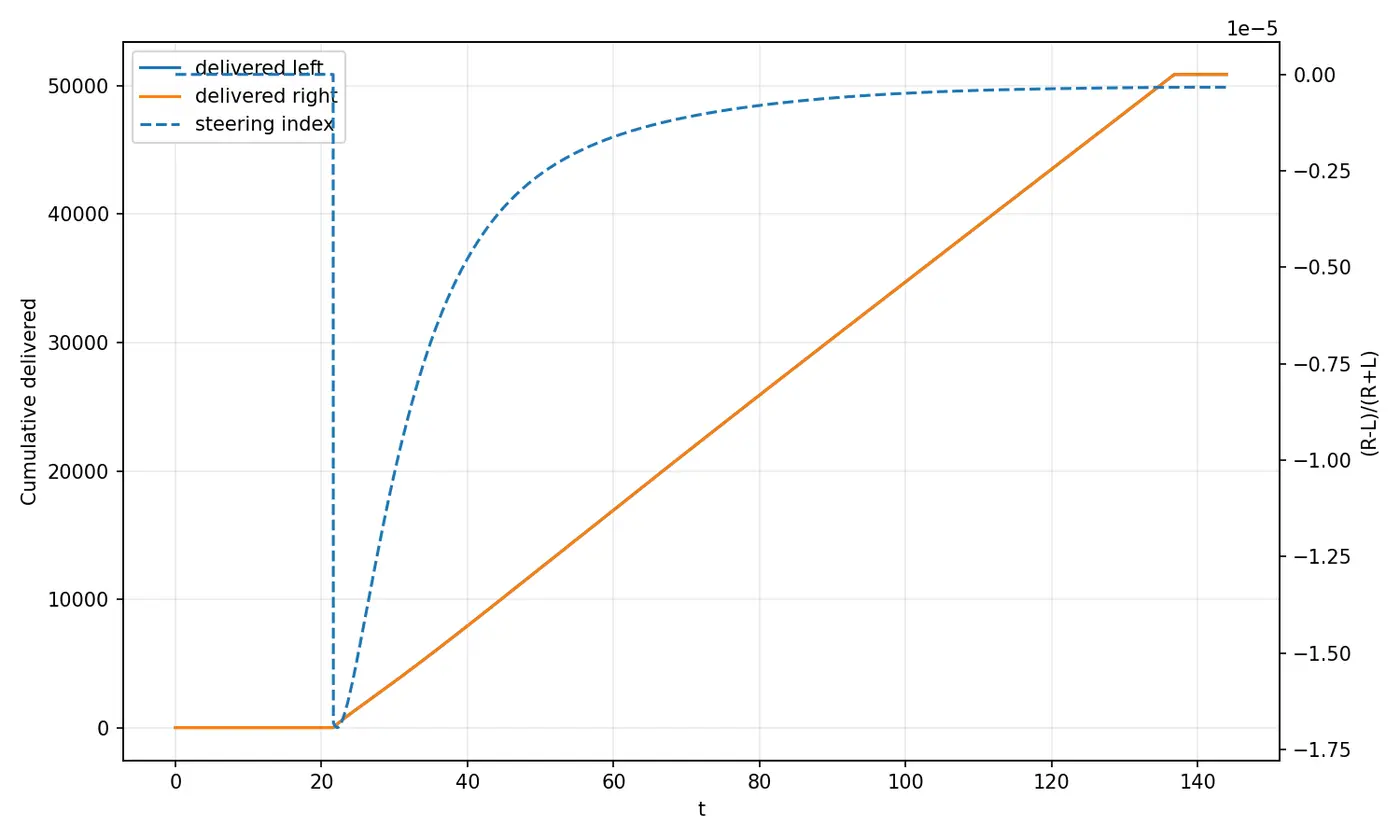
A phenomenological source–store–drain view of localized storage, guided release, repeated cycling, and bilateral steering.
Twenty charge–discharge–rest cycles and bilateral steering are tested in the public chain.
- The clean guided regime supports storage, controlled transport, repeated charge–discharge–rest cycles, and directional steering.
- A finite clean bias–drain window is identified; the bias-30 overdrive branch is excluded from clean claims.
- The regime reproduces across five seeds and selected 1536, 2048, and 4096 resolution checks.
BOUNDARY
CLAIM BOUNDARY
- 01Declared numerical protocol
E1–E9 · five seeds · 20 cycles · 1536/2048/4096 checks
- 02Supported model-level finding
The clean guided regime supports storage, controlled transport, repeated charge–discharge–rest cycles, and directional steering.
- Claim boundary
- 03Requires a separate validation chain
The Li-FLG layer is phenomenological. This is not an electrochemical cell model, DFT result, safety certificate, thermal closure, or device-level battery-performance claim.
Numerical evidence is not physical validation. Transfer to a material, device, organism, environment, or operational service requires a separate validation chain whenever such a transfer is relevant.
Publication record
- Author
- Nikita Teslia
- Programme
- Energy
- Claim type
- Numerical proof-of-concept
- Year
- 2026
- Dossier review
- Series
- E1–E9 · five seeds · 20 cycles · 1536/2048/4096 checks
- License
- CC BY-NC-ND 4.0
- DOI
- 10.5281/zenodo.20323370
Citation
Teslia, N. (2026). E2: Phase-Guided Li-FLG Accumulator. Zenodo. https://doi.org/10.5281/zenodo.20323370Open publication recordThe DOI is the canonical external record. The site condenses the public publication and does not replace it.
PROGRAMME TOPOLOGY
Research lineage
Lineage records publication sequence and explicit revision or supersession links. It does not assert empirical causation or an otherwise unverified cross-branch dependence.
No published successor is encoded in the current research graph.