
Research question
Which coating candidates survive sequential numerical controls and can be prioritized for paired physical tests without conflating release kinetics, biological efficacy, a hydrodynamic proxy and measured material performance?
MODEL SCOPE
Public model description
A staged, dimensionless phenomenological chain connects undisclosed composition descriptors, a coarse graphene-distribution field, mechanical ageing, surface state, release/exposure, fouling occupancy and a finite coating budget. A later monotonic uncertain mapping defines a hydrodynamic proxy. Paired no-graphene controls must recompute dependent priors. Biological admission and hydrodynamic-target admission are different endpoints; neither maps uniquely to manufactured coating performance. T2 supplies methodological context without transferring physical validation.
PROTOCOL
Declared evidence chain
AF1.1–AF1.12 preserve corrective detector tests, matched-control reconstruction, common-exposure mechanics, orientation-sensitive surface checks, release and biological controls, cycling/resource extensions, inverse search and non-overlapping forward batches. All 21 selected survivors reach the intermediate grid; only eight promotions plus two separate references are tested at the final grid. Seed ancestry and finite output stability qualify that transfer. ET-01 proposes separate integrity, water-exposure and attachment-removal tests, with a distinct species-specific module; it contributes no completed physical observations.
Series: AF1.1–AF1.12 · corrective audits · paired 0G controls · forward confirmation · grid transfer · experimental handoff
- AF1.1–AF1.12
- corrective audits
- paired 0G controls
- forward confirmation
- grid transfer
- experimental handoff
The labels below preserve the public protocol identity. They are an index to the publication, not a substitute for its full methods or an open reproducibility bundle.
EVIDENCE
Results inside the model
INTERACTIVE MODEL LENS
Coating evidence and endpoint lens
A categorical reading of corrected numerical checks, the failed strong biological gate, the separate hydrodynamic-target cascade and future physical testing. These gates explain the report; they do not simulate coating chemistry, fouling or vessel flow.
21 selected candidates pass the hydrodynamic-target cascade; all eight promotions and two references retain final-grid admission. This endpoint does not reverse the failed strong biological gate.
- The initial provisional screen admits 225,876 of 500,000 candidates (45.1752%). This is a sampling- and gate-dependent formulation-space fraction, not a manufactured-coating efficacy estimate. Detector, comparator and exposure-time corrections remain part of the evidence history.
- AF1.6–AF1.8 do not establish strong robust biological suppression under the inherited criterion. The tested near-surface exposure extension does not rescue the active branch. Useful temporal release flattening remains a transport result; later proxy admission does not reverse the biological verdict.
- Non-overlapping forward batches evaluate 6, 18 and 104 candidates and retain 2, 4 and 15 full hydrodynamic-target survivors: 21 of the selected 128-candidate queue. This does not identify a global optimum or a population success rate.
- All 21 survivors retain admission at the intermediate grid. Eight preselected promotions and two separately labelled references all pass the final-grid cascade. The other eleven intermediate-grid survivors were not tested at that final grid.
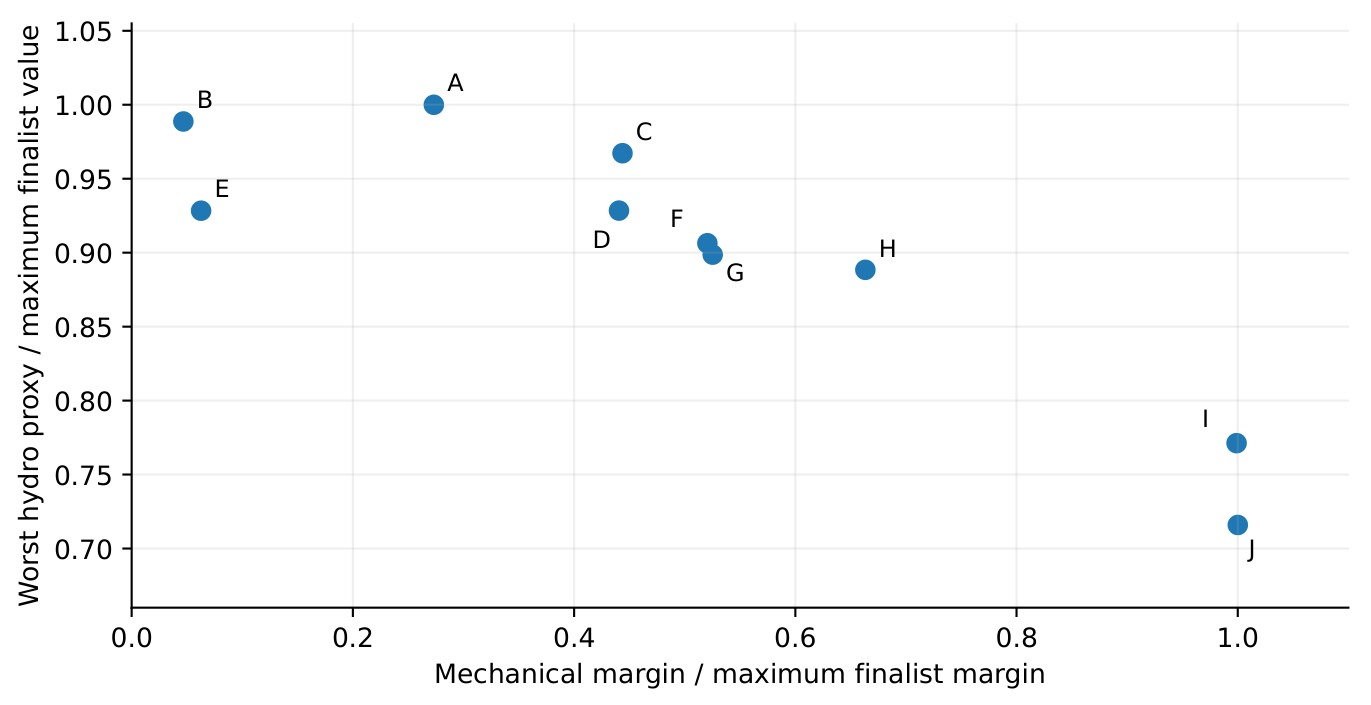
- Across the ten finalists, worst-scenario median hydrodynamic-proxy reduction is approximately 1.096–1.531%. Its relative intermediate-to-final change ranges from −1.19% to +0.46%. These are selected model outputs, not measured ship drag, fuel savings or a continuum-convergence proof.
- The handoff selects five role-diverse candidates, five paired no-graphene controls and five reserve finalists. Physical realization, laboratory acceptance and measured economics remain pending; the proposed integrity, water-exposure and attachment-removal tests are not completed experiments.
BOUNDARY
CLAIM BOUNDARY
- 01Declared numerical protocol
AF1.1–AF1.12 · corrective audits · paired 0G controls · forward confirmation · grid transfer · experimental handoff
- 02Supported model-level finding
The initial provisional screen admits 225,876 of 500,000 candidates (45.1752%). This is a sampling- and gate-dependent formulation-space fraction, not a manufactured-coating efficacy estimate. Detector, comparator and exposure-time corrections remain part of the evidence history.
- Claim boundary
- 03Requires a separate validation chain
The numerical chain uses dimensionless phenomenological closures, provisional priors and selected, dependent cohorts. Grid transfer checks seed ancestry and finite output stability without proving equivalent physical random fields or universal convergence. Real morphology, surface chemistry, adhesion, ageing, biological response, drag, fuel use, service life, toxicity and regulatory suitability are not established. Exact formulations, manufacturing procedures, operating settings, code, seeds and raw arrays remain outside the public release.
Numerical evidence is not physical validation. Transfer to a material, device, organism, environment, or operational service requires a separate validation chain whenever such a transfer is relevant.
Publication record
- Author
- Nikita Teslia
- Programme
- Marine coatings
- Claim type
- Numerical evidence ledger
- Year
- 2026
- Publication date
- Report version
- 1.1
- Report date
- Report languages
- English / Russian
- Dossier review
- Series
- AF1.1–AF1.12 · corrective audits · paired 0G controls · forward confirmation · grid transfer · experimental handoff
- License
- CC BY-NC-ND 4.0
- DOI
- 10.5281/zenodo.23166658
Citation
Teslia, N. (2026). AF1: A Claim-Bounded Numerical Audit of Graphene-Modified Marine Coatings: From Formulation-Space Screening to Experimental Handoff (Version 1.1). Zenodo. https://doi.org/10.5281/zenodo.23166658Open publication recordThe DOI is the canonical external record. The site condenses the public publication and does not replace it.
The Russian version of this work is available in the same Zenodo record, at the same link and under the same DOI. The two PDFs are parallel author versions of one report.
PROGRAMME TOPOLOGY
Research lineage
Lineage records publication sequence and explicit revision or supersession links. It does not assert empirical causation or an otherwise unverified cross-branch dependence.
No predecessor is asserted in the current research graph.
No published successor is encoded in the current research graph.